Trésor-Eco
Geopolitical Fragmentation of Trade
At a time of heightened geopolitical tensions, economic exchanges between nations are increasingly governed by a bloc-based approach. We are witnessing a reorganisation of trade between groups of geopolitically aligned countries, i.e. a geopolitical fragmentation of trade. This fragmentation began with the annexation of Crimea in 2014 and accelerated with Russia’s invasion of Ukraine in 2022.
At a time of heightened geopolitical tensions, economic exchanges between nations are increasingly governed by a bloc-based approach. We are witnessing a reorganisation of trade between groups of geopolitically aligned countries, i.e. a geopolitical fragmentation of trade.
According to our estimates covering a period preceding the second Trump administration, the fragmentation between blocs of military allies is more marked than between diplomatically aligned countries or countries maintaining close economic cooperation. This fragmentation began with the annexation of Crimea in 2014 and accelerated with Russia’s invasion of Ukraine in 2022.
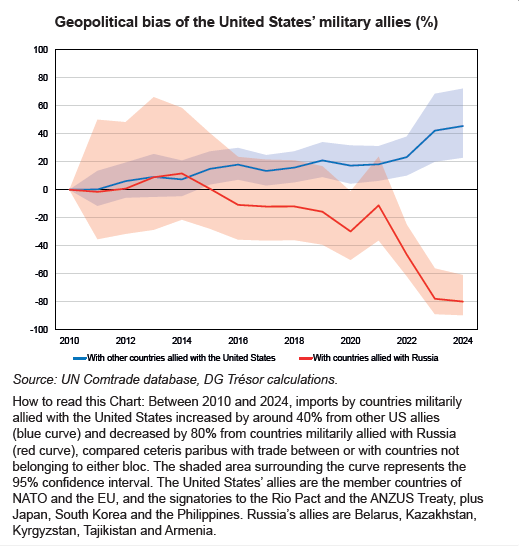
Since 2010, the military allies of the United States have increased their imports from other US-allied countries by around 40%, while imports from Russia’s military allies have decreased by 80% compared with trade between or with countries not belonging to either of these blocs (see Chart opposite).
Fragmentation can stem from strategies that address legitimate concerns, such as reducing unwanted dependencies. However, trade fragmentation would be less economically efficient than the free allocation of resources.
Similarly, reduced trade diversification could undermine the resilience of our economies. Lastly, fragmentation could hamper our ability to tackle global challenges such as the green transition and development.