Trésor-Eco
The Digital Sector: the Main Factor Behind the France-US Productivity Gap
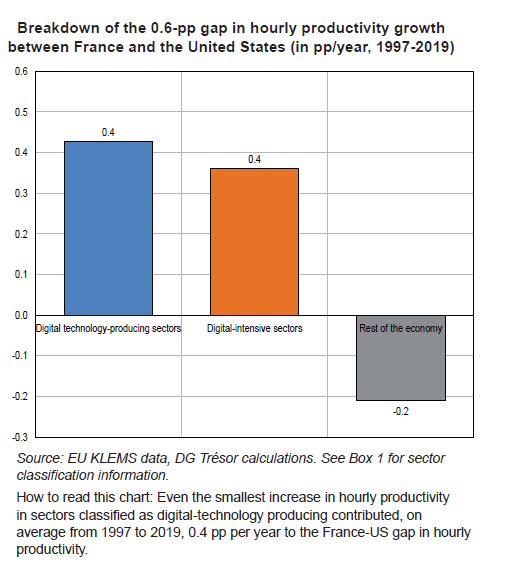
The France-US gap in hourly productivity growth was 0.6 pp/year from 1997 to 2019. The sole reason for this difference is lower productivity in France’s digital sectors among both digital technology-producing sectors and digital-intensive sectors. The development and mainstreaming of new digital technologies, such as AI, is therefore vital for future growth in France and Europe.
Stalling labour productivity in Europe relative to the United States since the mid-1990s has often been attributed to the digital sector, as noted in particular in the Draghi Report. The reason for this gap can be found in both the digital technology-producing sectors and the digital-intensive sectors.
The digital technology-producing sectors – encompassing electronics and digital services – account for less than 10% of French or US value added, but have seen steady productivity growth in the last 30 years, particularly in the United States.
The productivity of digital-intensive sectors (e.g. retail and wholesale trade, financial services), which make up around one-third of GDP in France and the United States, is significantly dependent on the adoption of new digital technologies.
From 1997 to 2019, hourly productivity grew on average by 0.6 percentage points (pp) per year faster in the United States than in France. According to our sectoral breakdown, the digital technology-producing and digital-intensive sectors contribute 0.8 pp per year to this gap, while France’s productivity, relative to that of the US, has increased slightly faster in the rest of the economy.
Artificial intelligence (AI) provides an opportunity for growth in the digital technology-producing and digital-intensive sectors. Public policy measures are being implemented to address the lag that French and European stakeholders are facing across the entire value chain, with the France 2030 Investment Plan lending support to research, innovation and industrialisation, the Osez l’IA (Dare to Try AI) plan backing firm-level AI uptake, and the European Commission proposing a tech sovereignty package.