Trésor-Eco
Oil, a Key Economic Variable That Remains Difficult to Forecast
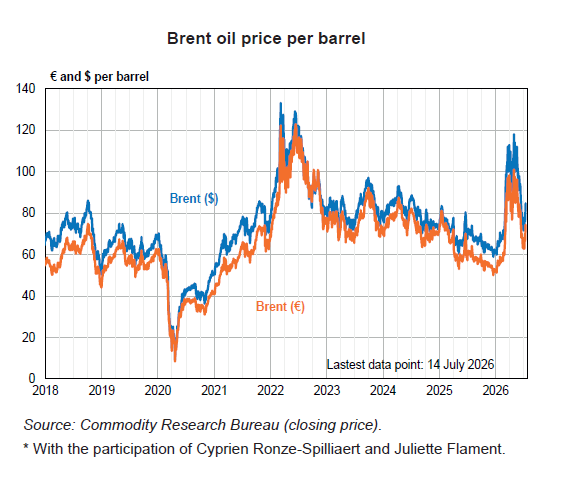
Oil is an essential resource for the global economy, especially for transportation and industry. Oil prices are driven by the balance between global supply and demand, as well as by market expectations. The 2026 conflict in the Middle East illustrates the influence of geopolitical tensions on oil prices, which affect the global economy primarily through the inflation channel.
Despite its relative decline in the global energy mix, oil is still a critical resource for the global economy, especially in transportation and industry. The oil trade depends on globalised supply chains and a number of strategic sea routes connecting the main oil-producing regions to the major consumer markets.
Oil prices are driven by the balance between global supply and demand, as well as by market expectations of future developments. The decisions of oil-producing countries, notably the United States, the world’s largest producer, and the members of OPEC+ (Organization of the Petroleum Exporting Countries and its partners) have a strong influence on prices, while growing demand in emerging economies is one of the main drivers of consumption.
Oil prices are also highly sensitive to geopolitical shocks. Recent tensions in the Middle East have confirmed the world economy’s continuing dependence on the Strait of Hormuz, a key chokepoint for oil transportation.
The macroeconomic impact of an oil shock varies according to a country’s energy mix, degree of energy dependency and geographical exposure. Oil shocks affect economies through three main channels: (i) inflation, which affects purchasing power and consumption, (ii) global demand, through the slowdown in activity in partner countries, and (iii) capital expenditure, as rising production costs erode corporate margins.
Oil prices are a key variable for the global macroeconomic outlook. However, forecasting is highly complicated due to the uncertainty surrounding price developments, high volatility and sensitivity to geopolitical events. In this context, the French Treasury (DG Trésor) generally uses the random walk forecasting method, which combines simplicity with forecasting performance. It may, however, deviate from this method, as in the spring of 2026, when exceptionally high prices are unlikely to persist.