Trésor-Eco
World Economic Outlook in Spring 2026: Global Economy Confronted with a New Energy Shock
The global economy has been significantly impacted by the conflict in the Middle East and the fresh energy shock that followed. The impact on the global growth outlook will depend on the duration and intensity of the conflict and is expected to vary across countries depending on their energy intensity and energy mix. However, the global growth outlook has been revised upward relative to the autumn 2025 forecasts, reflecting the smaller-than-anticipated impact of the US tariff shock.
The conflict in the Middle East has weighed on the global economic outlook and has heightened uncertainty. Its impact, however, will depend on the duration and intensity, and will differ across countries according to their energy intensity, energy mix and reliance on hydrocarbon imports.
The global growth outlook has nonetheless been revised upward relative to the autumn forecasts, as the impact of US tariff measures has been smaller than previously anticipated. Global growth is expected to reach 3.2% in both 2026 and 2027, following 3.3% in 2025.
Among advanced economies, growth in the United States is expected to pick up slightly in 2026, supported by the past depreciation of the US dollar and the country’s position as a net exporter of oil and natural gas, before moderating in 2027. Growth in the euro area and the United Kingdom is set to slow, as these economies are more exposed to the energy shock, with growth remaining heterogeneous across countries, notably owing to their respective fiscal policy stances.
In major emerging market economies, growth is projected to moderate slightly in 2026 and 2027. The effects of the conflict in the Middle East are expected to differ markedly depending on whether economies are net importers of hydrocarbons (India, China, Türkiye) or net exporters (Brazil).
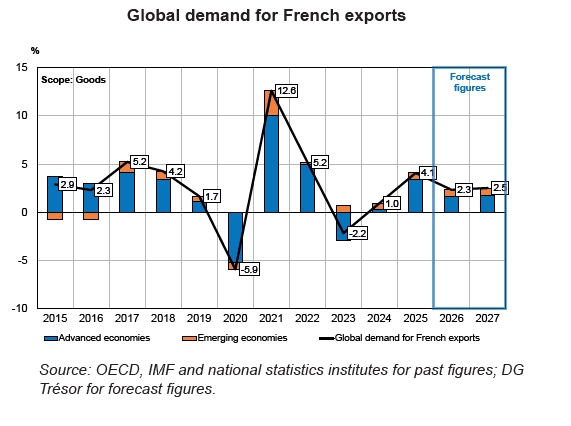
Global trade growth is set to slow sharply in 2026 (to 2.2%, after 4.3%), reflecting the full materialisation of the US tariff shock and the energy shock caused by the conflict in the Middle East. Global trade growth is then projected to recover to 2.8% in 2027, reaching its pre-pandemic average (2.8% from 2015 to 2019). In particular, trade in AI-related goods is expected to continue to support global trade growth.
These forecasts are highly uncertain, especially for 2027. The impact of the conflict in the Middle East will depend on its duration and intensity, as well as on the public policy responses adopted by other countries (only the measures announced to date have been taken into account). In addition, US trade policy remains a persistent source of uncertainty.