Trésor-Eco
The Outcomes and Objectives of Apprenticeships in France
Apprenticeship has grown sharply in popularity since 2018, driven by the deregulation of the system and increased government funding. Their growth has come alongside more diverse profiles, with apprentices often studying in higher education and more employers operating in the service sector. Apprenticeship facilitates the school-to-work transition, particularly at the occupational certification and secondary vocational school levels, but their impact is more limited at higher degree levels.
In France, apprenticeships in secondary and higher education settings combine on-the-job training with formal learning at an apprentice training centre. At the end of the training period, apprentices obtain an occupational qualification, such as a diploma, degree or other occupational certification. Apprenticeships are meant to foster the employability of young graduates.
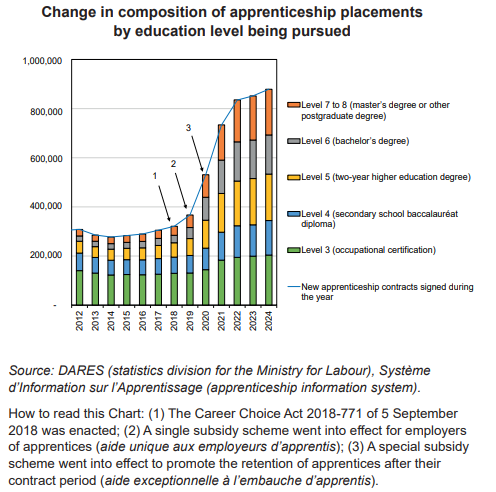
Since the 2018 reform of the system, apprenticeships have grown sharply in popularity among students pursuing their education. 879,000 new apprenticeship contracts were signed in 2024, compared to 306,000 in 2017, bringing the number of apprentices with an ongoing contract to one million at the end of 2024. This expansion was facilitated by the deregulation of the programmes offered by apprentice training centres. It was also bolstered by more flexible rules for contracts and the introduction of a government single subsidy scheme for employers of apprentices.
The sharp increase in apprenticeships has come with an almost tripled cost for the public purse. In 2023, the cost to public finances reached around €15bn, or €14,700 per apprentice. This level of government support is considerably higher than that of other European countries where apprenticeships are deeply rooted, such as Germany. Adjustments to apprenticeship support schemes in 2025 will help to curb their cost.
The rise in apprenticeships has occurred alongside major changes in the profiles of apprentices, who are now more likely to be students in higher education than in secondary school, and of employers, with a shift towards the service sector.
Apprenticeships are associated with an overall smoother transition from school to work for young people compared to academic-track students not doing an apprenticeship. For young people having obtained an occupational certification (certificat d’aptitude professionnelle – CAP) in 2021, 63% of apprentices were employed 18 months after their apprenticeship, compared to just 36% of academic-track students. This impact is less marked, however, as a person’s education level rises, and appears to be minimal at the master’s level.