Trésor-Eco
Forests and the Wood Sector: Key Pillars of the Green Transition and Economic Resilience
Forests and the wood sector are strategic assets that contribute to the resilience of the French economy and the green transition. They provide essential economic and environmental services, but are under pressure from climate change, the fragmentation of privately-owned forests and the lack of competitiveness in the processing industry. Public policies aim to strike a balance between ecosystem conservation, climate action and the sector’s economic development.
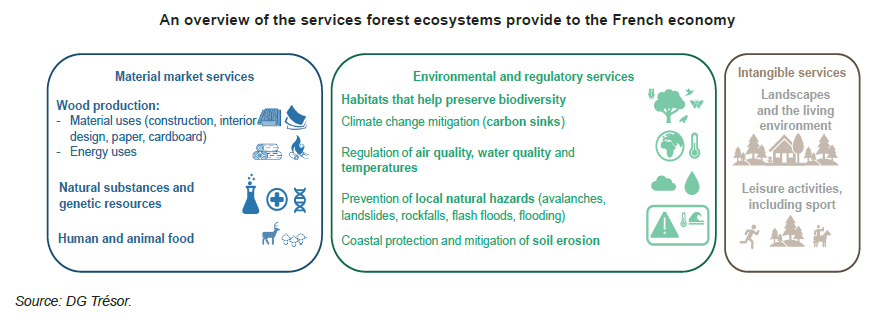
French forests, which have been steadily expanding in terms of surface area since the 19th century, and the associated wood sector are strategic assets for the French economy. Although their contribution to value-added, linked to wood and energy production, is modest (0.6% of GDP in 2023), forests provide essential services for tourism and recreational activities, the preservation of biodiversity, and the regulation of numerous environmental processes. In particular, carbon storage by forest ecosystems and the development of wood-based alternatives as substitutes for fossil fuels and materials play a crucial role in achieving climate neutrality.
These functions are coming under increasing threat. Natural and human-induced pressures, exacerbated by climate change, are damaging the health of French forests, threatening the services they provide. The fragmentation of privately-owned forests holds back their sustainable management and the utilisation of wood resources. Finally, the French wood processing industry is less competitive than its international counterparts, contributing to a trade deficit of €7.2 billion for wood products in 2025.
In light of these challenges, public policies aim to balance the conservation of forest ecosystems, climate change mitigation and adaptation, and the economic development of the sector. Measures promoting sustainable management, forest renewal and the resilience of forest stands should allow for the increased use of wood to support the decarbonisation of the economy, whilst preserving biodiversity and the other functions of forests. Incentives for the development of long-lasting wood products, particularly in construction, also help to maintain carbon sinks through the carbon stored in these products. evelopment in wood processing technologies is critical to increasing the value-added of wood products.