Trésor-Eco
Understanding Pathways Following Exhaustion of Unemployment Benefits
Approximately one-fifth of unemployment benefit outflows are due to benefits exhaustion. Although a large proportion of these former recipients find long-term employment in the year following the end of their entitlement to unemployment benefits, other pathways point to harder integration into employment. Administrative data is used to reconstitute and understand these pathways, correlating waged employment, income benefits and registration with France Travail, the national employment agency.
On average from mid-2021 to mid-2024, approximately 57,000 people per month exhausted their unemployment benefits, accounting for 23% of unemployment benefit outflows.
This study focuses on job seekers who reached the end of their entitlement to unemployment benefits in the second half of 2022 and analyses their pathways over the following year based on detailed administrative data (Midas data) correlating waged employment, income support and registration with the national employment agency (France Travail).
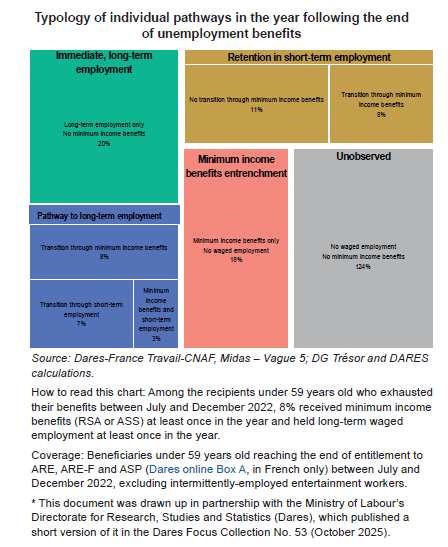
The return to long-term employment is often gradual. 31% of former unemployment benefit recipients who exhausted their entitlement were in waged employment three months after exhausting their benefits. A full 58% of these individuals had worked again at least once as an employee after a year. Many individuals experience multiple employment contracts before finding long-term employment. A majority remain registered with France Travail while employed, reflecting active albeit fragmented return-to-work pathways. Minimum income benefits act as a safety net during these transitional periods.
18% of exhaustees receive the Revenu de Solidarité Active (RSA) three months later and 11% receive the Allocation Spécifique de Solidarité (ASS).
Five typical pathways of equal weight are found over the year following unemployment benefits exhaustion (see chart).