Trésor-Eco
Climate Change, Low-Carbon Transition and Potential Growth
If climate change is left unchecked, it will have significant negative repercussions on French potential growth channelling through all of its components: labour, capital and total factor productivity (TFP). Although the low-carbon transition could trigger a slight downturn in potential growth in the short and medium term, channelling mainly through TFP, it will, in any event, generate long-term benefits, primarily in terms of the damage prevented.
Potential growth refers to the increase in output that an economy can sustain making full use of its capacities without generating price pressures. This study focuses on variations in potential growth due to climate change and the low-carbon transition. The comparative analysis takes a hypothetical scenario in which there is neither climate change nor transition in order to analyse their effects separately.
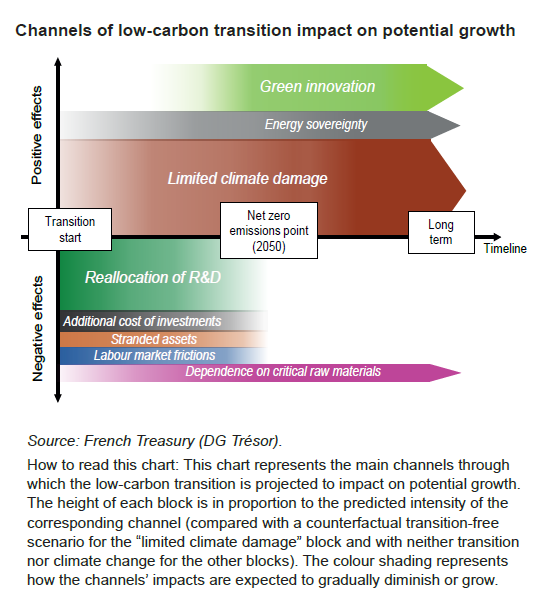
Climate change has a significant negative impact on potential growth, and this impact will only intensify if it is left unchecked. First, climate change represents a risk for the labour supply and worker productivity, which declines in particular during heatwaves. Second, it implies the destruction of assets due to the proliferation of extreme weather events and an investment-disincentivising increase in uncertainty. Third, it risks diverting some production factors and innovation into reconstruction and adaptation to the detriment of more productive areas.
The low-carbon transition will sharply reduce this negative impact. Yet, it could also trigger a slight downturn in potential growth in the short and medium term, albeit well below the long-term cumulative effects of unchecked climate change. Needs for innovation in low-carbon technologies risk crowding out a proportion of research and development in more productive sectors. Businesses will also need to replace their carbon assets, which could raise production costs. Lastly, job reallocations during the transition phase could temporarily reduce available labour in the event of a skills and geographic mismatch between new green jobs and destroyed brown jobs.
In the long run, there is the prospect that learning effects, innovation and the spread of technologies across the productive base could cause growth in productivity to return to, if not top the prevalent rate prior to the low-carbon transition (see chart).