Trésor-Eco
The Economic Impact of the Performance Levels of the French Education System
The academic results of students in France are deteriorating over time and compared with other countries, and are strongly affected by social factors and gender. Yet improving educational performance levels would be a source of long-term growth for the French economy. Assessment of education policies identifies the most effective actions and shows, in particular, the significant impact on academic performance of increasing the teacher-student ratio.
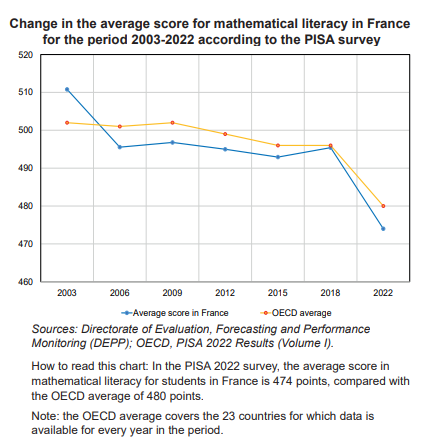
The academic performance levels of students in France are declining over time and in comparison with other countries. National assessments show a slump in academic achievement in mathematics and French over the past 30 years. A survey by the Programme for International Student Assessment (PISA) confirms this decline, which is faster than in other countries, although performance levels in France remain close to the OECD average and, out of OECD countries, are among the most strongly correlated with social background and reveal significant gender gaps.
Reversing the trend in educational performance levels would be a source of long-term growth for the French economy. Indeed, a large proportion of the productivity gains in developed economies can be explained by the accumulation of human capital, mainly acquired during initial training. Reducing gender and social inequality would increase the pool of potential innovators and skilled workers.
Assessment of education policies is essential, to identify the most effective actions and optimise their socio-economic impact. In particular, the literature shows that increasing the teacher-student ratio has a significant impact on academic performance levels. Teacher training and in-service professional development, as well as the appropriate and judicious use of digital resources, which are still underutilised in France, can also have a positive effect on learning.
Additional resources have been allocated to the education system in recent years (an 11% increase in domestic education expenditure in constant euros per student in primary education between 2017 and 2023). Halving of class sizes has been gradually implemented since the start of the 2017 academic year for students in the first and second years of primary school and in the final year of nursery school in priority education networks, to target students from disadvantaged social backgrounds in the acquisition of core knowledge.